

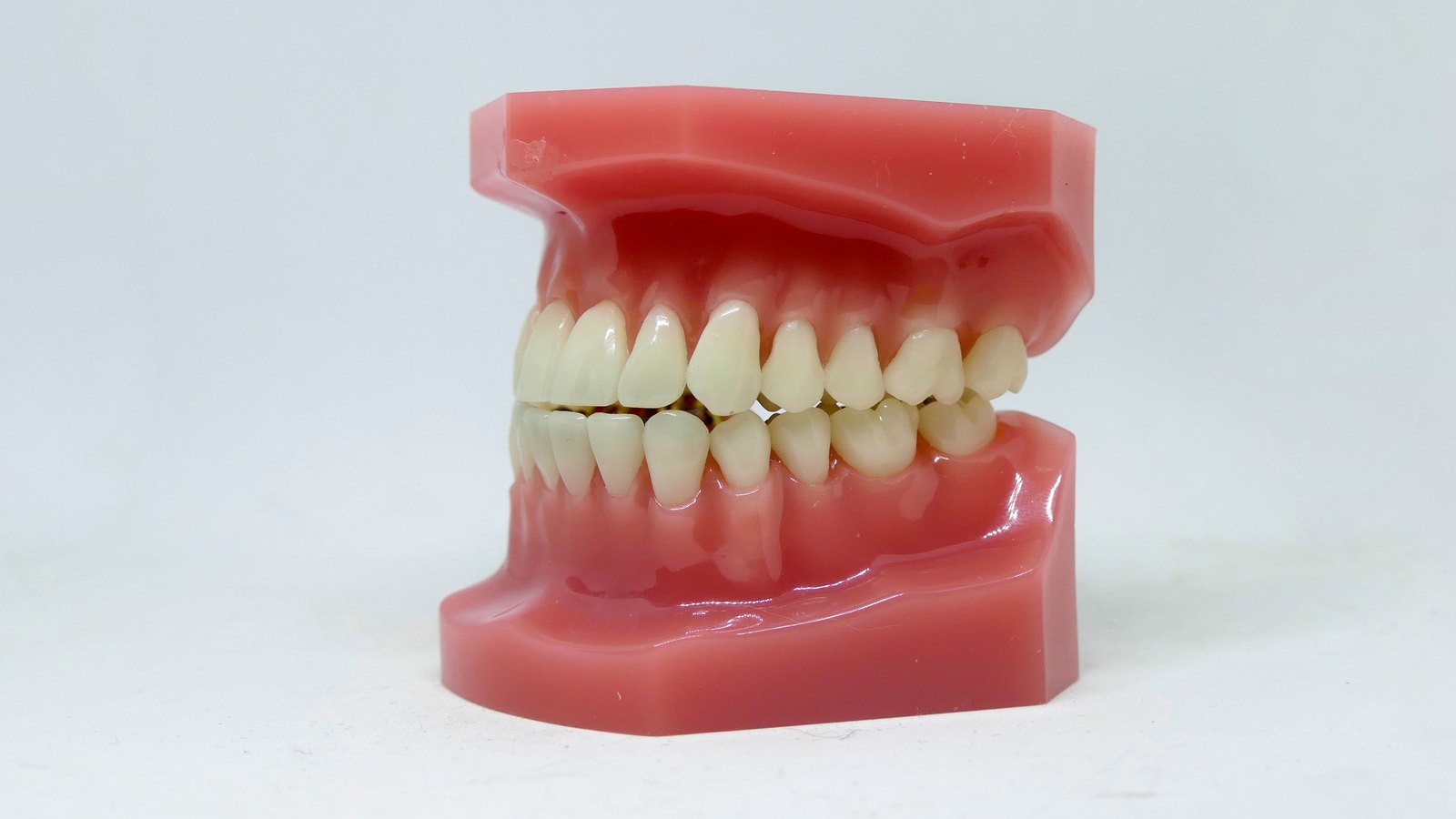
Can Invisalign fix an overbite, underbite or crossbite? It is one of the most common questions we hear from people who have been told their teeth do not line up the way they should, and the answers online range from “yes, easily” to “not a chance.”
The honest answer sits in the middle. This guide explains how the three bites differ, what the research measured instead of what marketing promises, why teeth versus jaw is the question that decides most cases, and when braces or a combination may fit better. It includes a bite guide with side-view drawings, and one of its outcomes says your bite may be better treated with braces. If you are looking for Invisalign in Overland Park, KS, it also explains where to start locally.
Teeth or jaw: what decides whether aligners can fix a bite?
Whether the bite comes from where your teeth sit or from how your jaws fit together. Clear aligners move teeth. Reshaping a jaw is a different job, and that difference is why one word, overbite for example, can describe a bite aligners handle well and one they do not.
A 2025 study of deep bites opens by noting that a deep bite can be caused by a skeletal, dental or dentoskeletal problem, and that treatment involves moving teeth in several ways (Orthodontics and Craniofacial Research). The American Association of Orthodontists (AAO) describes corrective jaw surgery as the remedy for skeletal problems that affect the ability to bite, chew and speak (AAO adult orthodontics).
| Bite | What it is | What the AAO says |
|---|---|---|
| Overbite | The upper front teeth significantly overlap the lower ones. | Adults can correct overbites with braces, clear aligners or sometimes surgery. |
| Underbite | The lower front teeth extend past the upper ones. | Braces or clear aligners can improve chewing and speech and reduce jaw pain and tooth wear. |
| Crossbite | Some upper teeth sit inside the lower teeth when you bite. | Treatment depends on the extent. For growing patients, a palatal expander followed by braces or aligners is common. |
| Open bite | A gap between the upper and lower teeth when the mouth is closed. | Adults can treat it with braces or clear aligners. |
Our own braces page says Invisalign can help with overbites, underbites, crossbites and open bites, with the caveat that some issues are easier to fix than others. Our Invisalign and braces page adds that we will tell you honestly if another approach would serve you better.
Can Invisalign fix an overbite?
Often, for mild to moderate overbites. The harder question is how much of the planned correction actually happens.
A 2025 retrospective study followed 36 patients with deep bites who were treated with one Invisalign system, SmartTrack. The achieved overbite reduction averaged 61% of what the plan prescribed, and the software’s planned movements often overestimated what was achieved. The authors found no significant link between that accuracy and the patient’s age, and concluded that clinicians should exercise caution in virtual planning.
Deep-bite patients treated with one Invisalign system: overbite reduction
What the 61% figure does and does not mean
It does not mean aligners fail 39% of the time. It means that on average the bite closed by about three fifths of the amount the plan asked for, which is why the authors suggest clinicians may need to adjust the software’s projections. The same study calls the result moderate accuracy. It also covers one aligner system and one group of patients, so treat it as a sense of the range, not a prediction for you. A 2025 systematic review in Cureus adds that aligner efficacy diminishes for complex movements, including significant overbite correction (Cureus review).
The AAO says an untreated overbite can cause tooth wear or lead to restorative work. If your plan does leave a little bite correction at the end, our guide to Invisalign refinements explains the extra aligners that may follow.
Can Invisalign fix an underbite?
Sometimes, mostly when the underbite comes from tooth position and not from the jaw. The AAO says treatment with braces or clear aligners can improve chewing and speech and reduce jaw pain and tooth wear.
The word itself is slippery. The AAO’s crossbite guide says underbite is often used when the top front teeth, or the jaw, sit behind the lower front teeth (AAO on crossbites). That is teeth, jaw or both under one label. When the lower jaw is the main driver, moving teeth alone may only go so far, and the AAO lists corrective jaw surgery as the remedy for skeletal problems.
The Cureus review describes Invisalign as a viable option for mild to moderate problems in non-growing patients, and notes that fixed appliances tend to give more accurate occlusal contacts in complex tooth movements. In plain terms, a small underbite and a large one are different conversations.
Can Invisalign fix a crossbite?
Sometimes, and the details matter more here than with the other bites. A crossbite means some upper teeth sit inside the lower teeth when you bite, and the AAO says it can be a posterior crossbite in the back, an anterior crossbite in the front, or a buccal crossbite where upper back teeth bite completely outside the lower ones.
The AAO says crossbites can come from genetics, baby teeth that were lost late, teeth that erupted abnormally, or habits such as thumb sucking, and that leaving one untreated may lead to the jaw shifting to one side, lopsided jaw growth or extra enamel wear. It says the plan depends on the extent. For growing patients, a common approach is a palatal expander to widen the upper jaw, then braces or aligners to reposition the teeth. An orthodontic specialist can decide on a method or a combination.
For adults, widening the arch is the sticking point. The Cureus review summarizes a 2025 study of arch expansion with Invisalign in 98 adults, which found that the expansion achieved was often smaller than planned, with underexpansion in 72.2% of measurements, and that expansion was less predictable in the upper arch and in the molars. That does not rule aligners out. It is a reason to ask how your provider plans to handle it.
Overbite, underbite or crossbite: which do you have?
Pick a bite to see a side-view drawing, then say how noticeable it is and your age group. The outcomes include one that says aligners are commonly considered and one that says braces may suit you better.
Pick your bite and see what may fit
Choose the bite, how noticeable it is and an age group. A conversation guide, not a diagnosis.
Not sure which bite you have, or whether aligners fit it? We are happy to take a look and talk it through.
Book a free consultWhen might braces or a combination work better?
When the correction is large, when the movement is one aligners find hard, or when the jaw is part of the picture. Research is fairly consistent on the direction, if not on the exact line.
The Cureus review says tooth movement predictability varies by type, with tipping the most accurate and rotation, intrusion and expansion less precise, and it cites recent evidence that fixed appliances tend to yield more accurate occlusal contacts and slightly higher success in complex tooth movements. The 2025 deep-bite study adds that elastics might be needed alongside aligners when there is also a Class II bite, and that precision bite ramps are a tool used in deep-bite cases.
None of that makes braces the winner in general. It makes the question specific to your bite. Our comparison of Invisalign and braces walks through the everyday trade-offs, and our guide for adults covers what matters if you wonder whether age is a barrier. The 2025 study found accuracy was not associated with age, and the AAO says one in three orthodontic patients is an adult.
Can you get Invisalign for a bad bite in Overland Park, KS?
Yes, and the first step is an exam, not a tray. If you are looking for Invisalign in Overland Park, KS, Love To Smile starts with a look at your teeth and bite and digital scans, so you can see what we are talking about, and in most cases a preview of the projected result. The same options are offered at our Peculiar office for Cass County patients, as our Invisalign in Peculiar, MO page explains.
A bite problem is more than a cosmetic one. Our Invisalign and braces page says crooked teeth and a bad bite can contribute to gum and bone loss, tooth decay, abnormal wear of tooth enamel surfaces, headaches and sometimes jaw and joint pain. The Greater Kansas City Dental Society lists similar signs among its 15 signs you should see a dentist: a jaw that pops or hurts when you open, chew or first wake up, and an uneven bite. If jaw pain is the bigger complaint, our page on TMJ treatment in Overland Park describes a conservative start with a custom night guard.
Families can plan around one practice. Our Johnson County page lists Invisalign for teens at the same office as adult care, and our guide to the signs your child needs orthodontic treatment is written for Overland Park parents. To book a bite check, call (913) 491-1200 for Overland Park or (816) 620-2022 for Peculiar.
What should you ask at the consult?
Five questions turn a general answer into one about your own bite. At our first visit we listen to what bothers you, examine your teeth and bite and take digital scans so you can see what we are talking about, and then talk through a plan.
- Is my bite coming from my teeth, my jaw or both?This is the question that decides most cases.
- How much of the correction do you expect aligners to deliver?The 61% study is a reason to ask for a straight answer.
- Would braces, or aligners plus something extra, do this better?A good answer includes the reasons, not only the recommendation.
- What happens if I wait?The AAO describes tooth wear and, for crossbites, jaw shifting as possible consequences of leaving a bite alone.
- What is the retainer plan afterward?Treatment ends with a retainer, and our guide to whether you have to wear a retainer forever explains what the AAO says.
Common questions
Can Invisalign fix an overbite without braces?
Often, for mild to moderate overbites. The AAO says adults can correct overbites with braces, clear aligners or sometimes surgery. A 2025 study of one Invisalign system found the achieved reduction averaged 61% of what was prescribed, so your provider may plan extra steps.
Can Invisalign fix a severe overbite?
Less predictably. A 2025 systematic review says aligner efficacy diminishes for complex movements such as significant overbite correction, and a bite caused mainly by the jaw may need braces, extra appliances or sometimes surgery. An exam shows which applies to you.
Can Invisalign fix an underbite?
Sometimes. The AAO says braces or clear aligners can improve an underbite, with better chewing and speech and less jaw pain and tooth wear. If the lower jaw is the main cause, moving teeth alone may only go so far, and your provider will tell you.
Can Invisalign fix a crossbite?
Sometimes. The AAO says the plan depends on the extent, and for growing patients a palatal expander is a common first step before braces or aligners. One 2025 study found aligners often achieved less arch expansion than planned, so ask how your provider would handle it.
How long does it take to fix a bite with Invisalign?
There is no single number. Time depends on how much your teeth and bite need to move, and on how consistently you wear the aligners. We give an honest range at the consult after examining your teeth and reviewing your scans, and the AAO notes adult treatment may take longer than a teen’s.
Is there Invisalign for an overbite or underbite near Overland Park, KS?
Love To Smile is a Diamond Provider of Invisalign with offices in Overland Park, KS and Peculiar, MO. A visit starts with an exam of your teeth and bite and digital scans, and your provider can say whether aligners, braces or a combination is likelier to suit your bite. Call (913) 491-1200 for Overland Park or (816) 620-2022 for Peculiar.
Curious what your bite needs?
A quick exam and digital scan show whether your bite comes from your teeth or your jaw, and which options fit. We will explain what we see in plain language.
Every case is different. This page is general education, not a treatment plan.
Want answers like this at the top of your search results?
Add Love To Smile as a Preferred Source on GoogleRequest an appointment
We would love to hear from you. Send us a message and our team will reach out to get you scheduled.