


Am I too old for braces? It is one of the most common questions adults ask about their teeth, and the people asking are in good company. The American Association of Orthodontists says one in three orthodontic patients is an adult.
The honest answer does come with a few conditions. This guide covers what really decides whether adult braces or clear aligners will work, what changes after your teens, and how to find out in a single visit. It also tells you when you may not need treatment at all.
Am I too old for braces? Is there an age limit?
No. There is no age cutoff for braces, and the people who study tooth movement say so plainly. The American Association of Orthodontists (AAO) explains that whether you are 8 or 80, the process that moves teeth through bone is the same, because teeth respond to forces applied over time (AAO: how old is too old for braces). The ADA’s MouthHealthy site agrees that healthy teeth can be treated at any age, even though treatment that begins during growth tends to give the best results (ADA MouthHealthy on braces).
Ching-Chang Ko, DDS, PhD, an orthodontist who chairs the Division of Orthodontics at The Ohio State University College of Dentistry, goes a step further in an Ohio State health article. Dr. Ko writes that there is no age limit as long as you are healthy, and reports treating patients in their 70s and 80s.
What our practice sees
A large percentage of the patients at Love To Smile are adults. Our Invisalign and braces page says it is never too late to improve your smile, and our options include metal braces, clear braces and Invisalign. If you want the local version of this answer, our page on braces for adults in Overland Park covers how a first visit works.
What actually matters more than your age?
Your gums, your bone and the dental work you already have matter more than your birthday. Those are the things an orthodontist checks first, and any of them can change the plan without closing the door on straighter teeth.
Healthy gums and enough bone
Dr. Ko writes that whether you are a good candidate depends on how much bone is left holding your teeth. If your gums and bone have not shrunk too much, braces will likely work. If your gums are inflamed, a dental cleaning to reduce the inflammation may be needed first, because inflammation can cause uncontrolled bone loss once braces are applied. Dr. Ko also notes that untreated gum disease can destroy the bone that supports your teeth.
Dental work you already have
The AAO lists fillings, missing teeth, misshapen or worn teeth and dental disease among the factors an orthodontist weighs, and says orthodontists often work with your dentist, and sometimes with other specialists such as periodontists and endodontists. Dr. Ko adds that decay may call for treatment such as a crown or root canal before your teeth are straightened. Our adult braces page makes the same point: many of our patients have crowns, veneers or implants that have to be accounted for in the plan.
Health conditions and habits
Dr. Ko lists diabetes and osteoporosis as conditions that might prevent braces in some adults, which is one reason to share your full health history at the first visit. The AAO says some medications and habits, including smoking, clenching or grinding, and tongue thrusting, can affect the outcome of treatment.
How is adult orthodontic treatment different?
Adult treatment works the same way, but it may take a little longer. The biggest difference, the AAO says, is that adults are no longer growing. That does not hurt the odds of success, though adult bone is denser and more mature, so treatment may take slightly longer than it would for a child with a similar problem (AAO). Dr. Ko puts the typical adolescent case at about two years and says adults can take longer because the cellular response in bone slows with age.
For a rough sense of the timeline, the ADA says most people are in treatment for one to three years, followed by a period of wearing a retainer that holds teeth in their new positions.
What stays the same
Orthodontists use an appliance to deliver gentle, controlled forces that move teeth, and the AAO names braces and clear aligners as the most common appliances for adults. Many problems can be corrected as easily for adults as for children and teens. Adults can also correct an overbite with braces, aligners or, sometimes, surgery.
What a realistic result looks like
Dr. Ko adds a practical note: if you are not counting on a perfect smile, fairly straight teeth are a reasonable goal as an adult. Your orthodontist can tell you what is possible for your teeth.
Braces or clear aligners: which is better for adults?
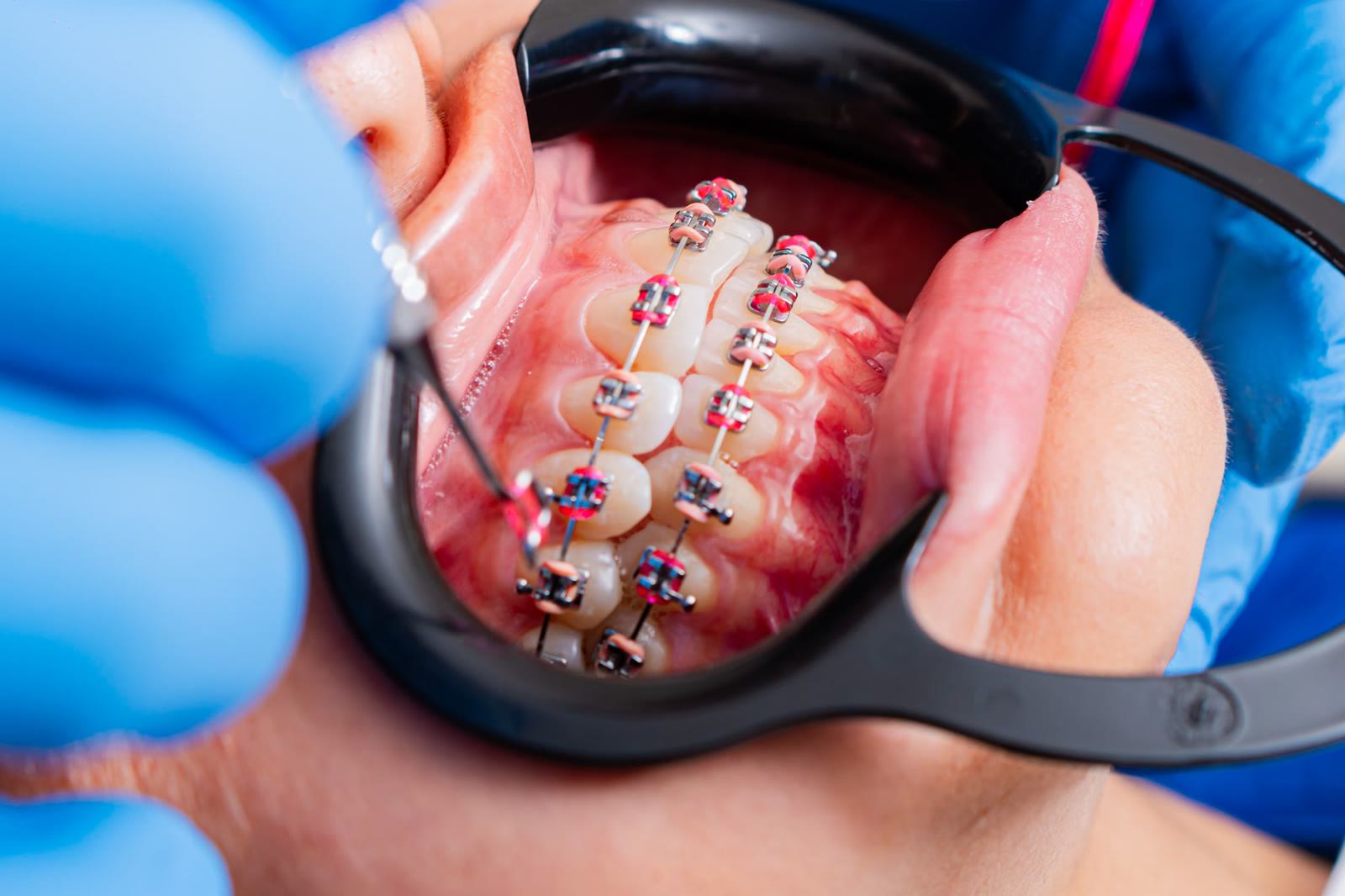
Both work for adults, and the better one depends on what your teeth need to do. Dr. Ko says braces are generally more effective than aligners, and that aligners may take longer for the same tooth movement. A 2025 systematic review in Cureus notes that Invisalign is a viable option for mild to moderate problems in people who have finished growing, but that it works less well for more complex movements such as arch expansion, significant overbite correction and closing extraction spaces (Cureus review).
| Braces | Clear aligners | |
|---|---|---|
| How they work | Brackets are fixed to the teeth and wires move them. | Clear, thin plastic trays shaped to fit your teeth. |
| Who is in control | They stay on until your orthodontist takes them off. | You insert and remove them, so they only work when you wear them. |
| Eating and cleaning | Sticky or crunchy foods can damage brackets, and flossing takes more time around the wires. | Removable, so you can eat and brush and floss as usual. |
| Complex tooth movement | Generally more effective for the same movement, per Ohio State’s orthodontic chair. | Less effective for movements such as arch expansion or significant overbite correction. |
| How they look | Metal or clear brackets. | Nearly invisible. |
That does not make aligners a lesser choice. Many adults have problems well within their range, and aligners are removable and nearly invisible, which suits some lifestyles better. Our own comparison of Invisalign and braces for adults and teens goes deeper on that trade-off.
The catch with aligners
Aligners only work while they are in your mouth. The Cureus review identifies inadequate wear time as a major cause of suboptimal outcomes. If you know you will not wear them most of the day, braces may suit you better, and that is a perfectly good reason to choose them.
Are you a good candidate? An age and readiness check
Four questions will not replace an exam, but they can show what an orthodontist would look at first. One of the results says you may not need treatment at all.
Is your age holding you back, or is it something else?
Slide to your age, answer four questions, and see what an orthodontist would look at first. A planning aid, not a diagnosis.
Wondering whether your teeth and gums are ready? A free consultation can answer it.
Book a free consultWill you need a retainer afterward?
Yes, for most people, and it is the part of treatment that lasts longest. A retainer holds your teeth in their new positions after braces or aligners come off. The ADA says treatment is followed by a period of wearing one, and the AAO says your orthodontist will likely advise wearing it for an extended period (AAO adult orthodontics FAQ).
Dr. Ko explains why: the tissue in your mouth tends to pull teeth back toward where they were. Ohio State patients are told a retainer is for life, and are asked to wear it all day for the first three months, then eventually at night. At Love To Smile, we fit you with a retainer when treatment ends so your smile stays put.
What should you ask at an adult braces consultation?
Bring a short list so the visit answers your real questions. These five cover most of what matters:
- What do my gums and bone look like?This is the first thing that decides whether you can start.
- Does anything need treatment first?Ask about decay, gum inflammation and any work that has to be coordinated.
- Which option fits my goals, and why?Ask to hear the case for braces, clear braces and aligners side by side.
- How long might my case take?Our adult braces page says we give you an honest range at the consult rather than a one-size-fits-all promise.
- What is the retainer plan?Ask what you will wear, and when.
At Love To Smile, the first visit is a free consultation. Our adult braces page describes how it works: we examine your teeth and bite, take digital scans and, in most cases, show you a preview of how your smile is projected to look at the finish line before you commit to anything. A good consultation can also end with the answer that you are fine as you are, and that is as valid as any other.
Common questions
Is 40 too old for braces?
No. The AAO says age is rarely a deciding factor, and one in three orthodontic patients is an adult. At 40, what matters is the health of your gums and bone and any dental work you already have, which an orthodontist checks at a first visit.
How old is too old for braces?
There is no upper age limit. The AAO says the process that moves teeth through bone is the same at 8 or 80, and an Ohio State orthodontist reports treating patients in their 70s and 80s. Gum disease, bone loss and some health conditions can complicate treatment, so share your history with your orthodontist.
Do braces work as well for adults as for teenagers?
They often can. The AAO says treatment can be as successful for adults as for adolescents, though adult treatment may take slightly longer because adult bone is denser and more mature.
How long do adults wear braces?
The ADA says most people are in treatment for one to three years, followed by a retainer. Adult treatment may take a little longer than a teenager’s, and your orthodontist can give you a range for your own teeth.
Can I get braces if I have gum disease or missing teeth?
Often, in stages. Ohio State’s orthodontic chair writes that inflamed gums may need treatment first because inflammation can cause uncontrolled bone loss once braces are applied, and the AAO says missing teeth and fillings are among the factors your dentist and orthodontist plan around.
Are clear aligners an option for adults?
Yes. The AAO lists clear aligners and braces as the two most common adult appliances. A 2025 review in Cureus notes that Invisalign is viable for mild to moderate problems and less effective for more complex movements, so which one fits depends on your teeth.
Ready to find out where you stand?
Bring your questions. We will check your teeth, gums and bite, explain your options in plain language and give you a straight answer about what fits.
Straightening plans depend on an exam and X-rays. This page is general education, not a treatment plan.
Want answers like this at the top of your search results?
Add Love To Smile as a Preferred Source on GoogleRequest an appointment
We would love to hear from you. Send us a message and our team will reach out to get you scheduled.